


.svg)
Ron Trent’s first LP in 11 years, ‘What Do the Stars Say to You’, is shaping up to be one of the albums of the year. Just don’t, whatever you do, call it house he tells Ben Cardew…

Ron Trent would like to make one thing clear: ‘What Do the Stars Say to You’, his new album as WARM, is not house music, OK?
“Is it house? Oh, absolutely not,” he says with a large smile, down the Zoom line from Chicago where he is back in the old family home. Which is fine, of course. He’s Ron Trent, a producer and DJ of exquisite talent, who has been making electrifying dance music since the tender age of 14 when he produced the early house/techno classic ‘Altered States’.
At the same time, though, wait a moment: he’s Ron Trent, the same Ron Trent who kept the deep house flag flying through the 1990s and beyond, with his none-more-musically profound label Prescription (with Chez Damier). This is the Ron Trent who produced scuba deep house classics like ‘Morning Factory’ and ‘The Choice’ (both with Damier) and who spun at NYC’s sacred house hangout Body & Soul. Surely he’s not giving up on his roots, right at the moment when the mainstream media is proclaiming 2022 to be the summer of house?
Well, no. Not really. Obviously it is way beyond our pay grade to tell Ron Trent what is and isn’t house. But ‘What Do the Stars Say to You’ feels a lot like house, albeit a kind of house made for lounging in a disco hammock, occasionally twitching a limb, as a cool summer breeze comes in off the sea. Songs like ‘Melt Into You (feat. Alex Malheiros)’ and the gorgeously indolent ‘WARM’ sound like house of a certain age, house music for deep diggers and musical thinkers, rather than tech housers and impatient festival dancers.
This is a house music album that is home to a septuagenarian jazz violinist trained at the Conservatoire de Paris (Jean-Luc Ponty) and an Italian composer in his 60s (Gigi Masin), alongside New York disco legend François Kevorkian and musically promiscuous festival headliners Khruangbin; a house music album that embraces synths and a gentle four-four pulse, as well as the dual (and perhaps contradictory) influences of kraut and yacht rock.
Sure, there are elements of jazz (witness Ponty’s sparkling solo on ‘Sphere’), Afrobeat (Khruangbin’s funk glide on ‘Flos Potentia (Sugar, Cotton, Tabacco)’), New Age (the admirably horizontal ‘Admira’) and even Detroit techno (the synth sweeps on ‘Cycle Of Many’) to the album. But then house music has always been a very adaptable beast, capable of making pretty with everything from gospel to soca, and ‘What Do the Stars…’ feels like a continuation of this warm-hearted, open-minded spirit.
Putting all this together took time. ‘What Do the Stars Say to You’ is Trent’s first album in 11 years, a lifetime in electronic music terms, and he has been quietly working away on the record, honing his musical skills. Rather than getting in his way, necessarily, Covid gave Trent a convenient excuse to improve his guitar skills, one of several instruments he plays on the album, alongside drums, percussion, keys, synths, piano and electronics. WARM is a band, Trent says, albeit one that very much starts with him.

This organic approach was a deliberate reaction to the way that a lot of modern electronic music is made, using laptops and plug ins.
“It’s really like taking a look back at the craftsmanship of the 80s and the 70s, where there was a combination of live music and electronic and not so much one or the other,” Trent explains. “You have albums that are mainly just electronic or mainly live. I like the combination of the two together, when they’re working together, you know, because it makes another whole layer of beauty.”
Trent’s key influences on ‘What Do the Stars…’ reflect this eclectic musical spirit. They include Brazilian jazz fusionists Azymuth (whose Ivan Conti and Alex Malheiros feature on the album); ‘Gigolos Get Lonely Too’, a 1982 song by The Time that was produced and composed by Prince, putting treated drum machine alongside live drums; Tangerine Dream; and – perhaps most intriguingly – Kraftwerk’s pre-Kraftwerk band Organisation, who released one album of spiralling, psychedelic krautrock before Ralf Hütter and Florian Schneider decamped to make musical history.
Organisation, it’s suggested to Trent, isn’t a name you hear every day. He seems amused. “It’s travelling music, it’s very visual,” he explains of the band’s deep-kraut appeal. “It’s highly textured, also abstract, for sure. I like those kinds of things: it allows the mind to have its own travelling session, if you will. And that’s very much what this album is about: it’s about being transported into different spaces and places. And also it’s kind of an ode to structures: architectural structures, sonic structures, visual components, design, things of that nature, cityscapes.”
The album’s striking cover art, by Italian architect and illustrator Federica Scalise, which depicts a modern, lightly surreal cityscape glimpsed through the window of a minimalist apartment, speaks to these structural concerns.
Ron Trent, it turns out, loves to talk about music. His current favourites include Thundercat, Robert Glasper, Khruangbin and English rapper/producer/songwriter Labrinth, who he discovered via his daughter’s love for HBO teen drama ‘Euphoria’, which Labrinth scored. These are far from your typical house favourites. But, in many ways, Trent continues to see the world through a DJ’s eyes. When he’s asked what he likes about Organisation, he starts to enthuse about ‘Tone Float’, the 20-minute-plus opening track that dominates the band’s debut (and, indeed, only) album.

“It’s a long, long track and it’s very atmospheric and you could play that record at the right time,” Trent explains, “say at The Loft [David Mancuso’s legendary New York party]. Or if I’m playing a long set somewhere in Japan, or if I’m playing by myself for a long period of time, I could play something like that.”
In the same way, he believes that the music on ‘What Do the Stars…’ could, in the right circumstances, move an open-minded dance floor. “At the right time and the right place, you could play tunes from this album in those zones,” he says. “François [Kevorkian] and I did a party together and we kind of demonstrated that attitude – that attitude, that altitude – will allow you to deliver the music in a certain way. It would all make sense in a dance formula.” (Kevorkian, as well as mastering ‘What Do the Stars…’, has also provided a mixed version of the album for digital release.)
And what is the secret to this dance formula? How can you make ‘What Do the Stars…’ work on a dancefloor? It comes down to context, Trent explains.
“My style of playing, the school I come from, it’s about telling the story,” he says. “So it’s really about what you surround it with, the textures that you surround the songs with.”
He digs back into krautrock to find an example of what he means. “Kraftwerk has had a big influence on electronic music, along with Tangerine Dream, along with George Kranz, those are krautrock groups and krautrock people. And Manuel Göttsching, Ash Ra Tempel, those tunes like [Göttsching’s] ‘E2-E4’ and ‘Shuttlecock’ (another Göttsching classic, notably favoured by Joe Claussell), you can easily play them on the dancefloor, at certain moments. Along with tunes like Herb Alpert’s ‘Rotation’. It’s all in that same world. It’s just a matter of being able to have the insight to understand the dialect, if you will, to deliver it.”
So when Trent says ‘What Do the Stars Say to You’ isn’t house music, he isn’t rejecting house, exactly. Rather, it feels like a reaction against what much modern house music has become. “How can I say this?” Trent ponders. “House music, as people are using it today, it has absolutely nothing to do with where it comes from or what it’s about. Because really, it’s an amalgamation of a lot of types of styles.
“What house music is, especially before it became formulaic, where it’s four on the floor and it does this and it does that blah, blah, blah, house music comes from The Loft; it comes from The Gallery; it comes from Paradise Garage. It comes from rock, it comes from gospel, jazz… So when someone says: ‘House music’, they’re really talking about a consciousness or a style, versus it being something that is a formula. This is a more krautrock, Balearic, yacht rock, rock, New Age, experimental album. But knowing what I know: people like David Mancuso and Frankie [Knuckles] and Larry [Levan] were very experimental and they had open minds for music. So it’s more of a music lover’s album.”
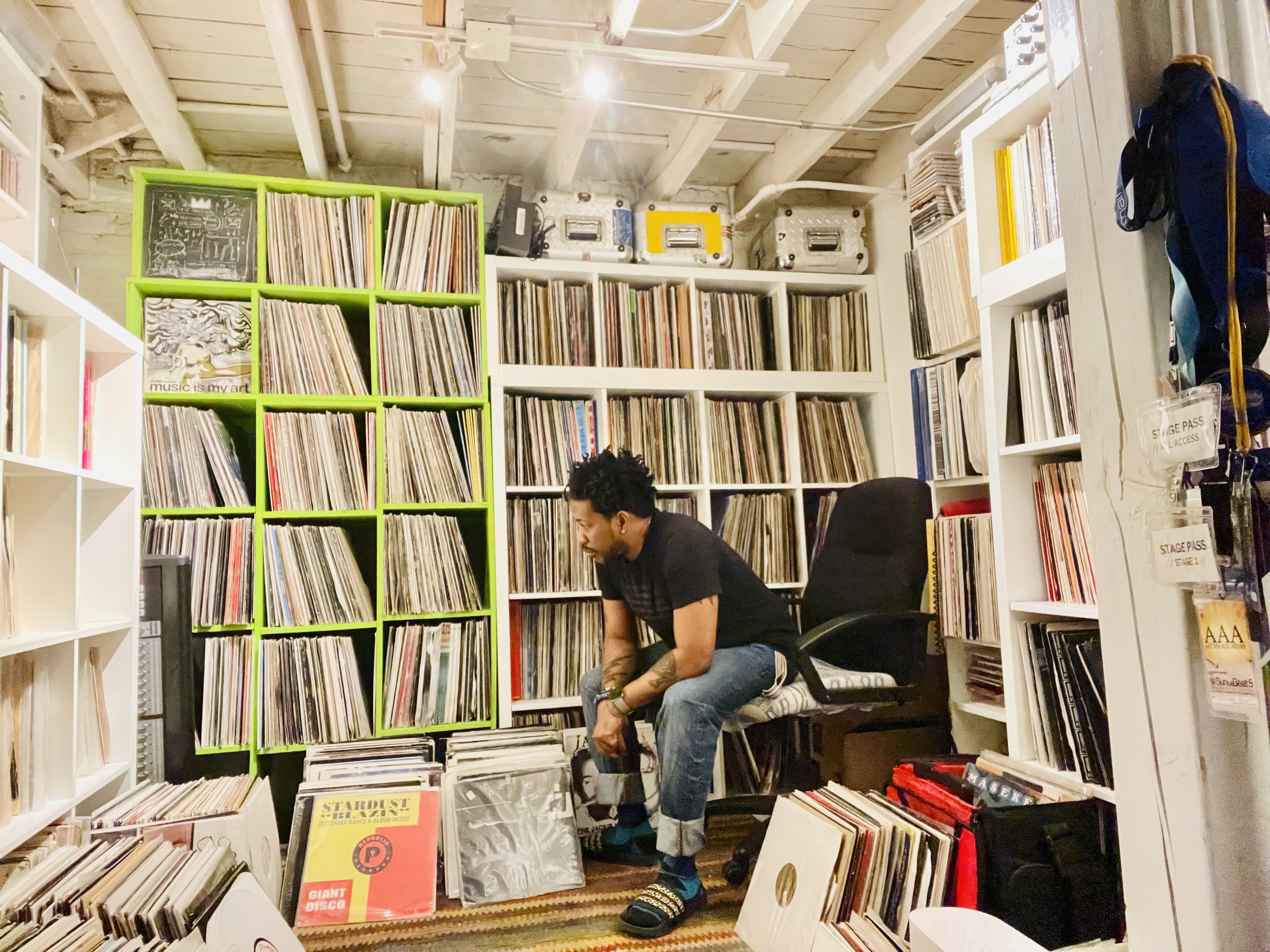
Don’t get it twisted. Trent likes Beyoncé and recognises her recent excursions into house music. (“She’s an artist,” he says. “And I can appreciate what she’s doing now, obviously, with the house music thing because of the statement that she’s making in terms of being a reclamation project. So I appreciate it.”)
Chicago’s current club scene, however, is less to his tastes. “It’s definitely a shadow of itself,” Trent says of the city that gave birth to house music, the city where he was born back in 1973, and made his first steps as a DJ and producer. “I came up in the beginnings of it [Chicago house] and pioneered a lot of it, on my end and my generation. Now it’s definitely more about drinking. And less about the sound system, less about the skill set… You know, what? Fuck it. It is heavily commercialised and there’s no underground. That’s the best way to describe it.”
To anyone who has grown up idealising the raw future funk of Chicago house – and that is everyone from Basement Jaxx to Daft Punk – this is a troubling thing to hear. So why has the city’s club scene has gone downhill?
He thinks for a while. “When something loses its connection to its roots, it dilutes the potency of what it is,” he eventually answers. “That’s kind of like what has happened in Chicago.” He contrasts this with New York, another city close to his heart. “I was there pre-9-11,” he says. “And the energy, man, it just reminded me of what it was like [in Chicago], you know, that freshness.”
New York, he explains, has been able to maintain a balance between commercialism and the underground in a way that Chicago has failed to do. “A lot of the underground here was kind of wiped away, in a sense, because of corporations, because of laws, because of just various things,” Trent explains, a note of weary sadness in his voice. “So it made it harder for people to create underground situations, where you could have a house for the cutting edge. And it is the edginess that made this happen in the first place. You know, it was somebody thinking outside the box, a DIY philosophy.”

Speaking to Trent today, it is obvious he has been on a musical journey since he burst onto the scene with ‘Altered States’ while still in high school. He’s older now – we’re all older now – and ‘What Do the Stars Say to You’ is an album both from and for people of age and experience. It’s relaxed, untroubled and musically accomplished; it’s profound, polite and slightly hippy in its New Age concerns; it is house that will gently give you a heartfelt hug rather than an electrifying jolt of excitement. And yet the same slightly naughty, non-conformist spirit that made ‘Altered States’ such a musical slap in the face in the early-90s is still undeniably present in Trent’s work.
Before our time is up, an exploration of ‘Altered States’. There’s one bar, around two minutes 43 seconds into the song, when the drums radically break from their steady rhythm; it’s a moment that used to mess up listeners in those long after-club nights, with the irregular drum rhythm making it sound like the mix was being trainwrecked. So, was this deliberate? Did he do it just to mess DJs and dancers up?
He laughs heartily. “No,” Trent says, amused by the idea. “If you listen to the track, it has a shuffle to it. That’s something that hadn’t really been done or played with, in a lot of tracks at that time. And so I was playing with shuffle, more than anything else, and with timing, more than ‘I’m gonna fuck you up on it’. When we’re creating tracks, we like quirky things. And that was quite quirky. You know what I mean? Something that was like: ‘Wow, did that just do that? Like what? Oh, shit!’ you know?”
It was, he concludes, an “edgy” move. “And so that was the purpose. It’s like: ‘This is some wild shit: it just did a thing we’re not used to.’” Again, Trent laughs deeply, as well he might. Ron Trent’s career has been one of musical adventure and exquisite control. It has also, beyond doubt, been one of wild shit and things we’re not used to. Long may that continue.
This article first appeared in issue two of Disco Pogo.
.jpg)


