.svg)
Don’t be sad that Saint Etienne are no more, instead smile as you remember the joy they’ve brought us over 35 years. From Balearic pop to indie dance, from folktronica, ambient and Euro dance to back where they began, Sarah Cracknell, Bob Stanley and Pete Wiggs have become one of our most beloved musical mainstays. In an emotional interview, looking back over the last four decades, the trio reflect on a job well done with Jim Butler. “We felt like we were making a bit of a difference, that we were doing something that was important,” says Cracknell…
“Remember, George: no man is a failure who has friends.”
‘It’s a Wonderful Life’
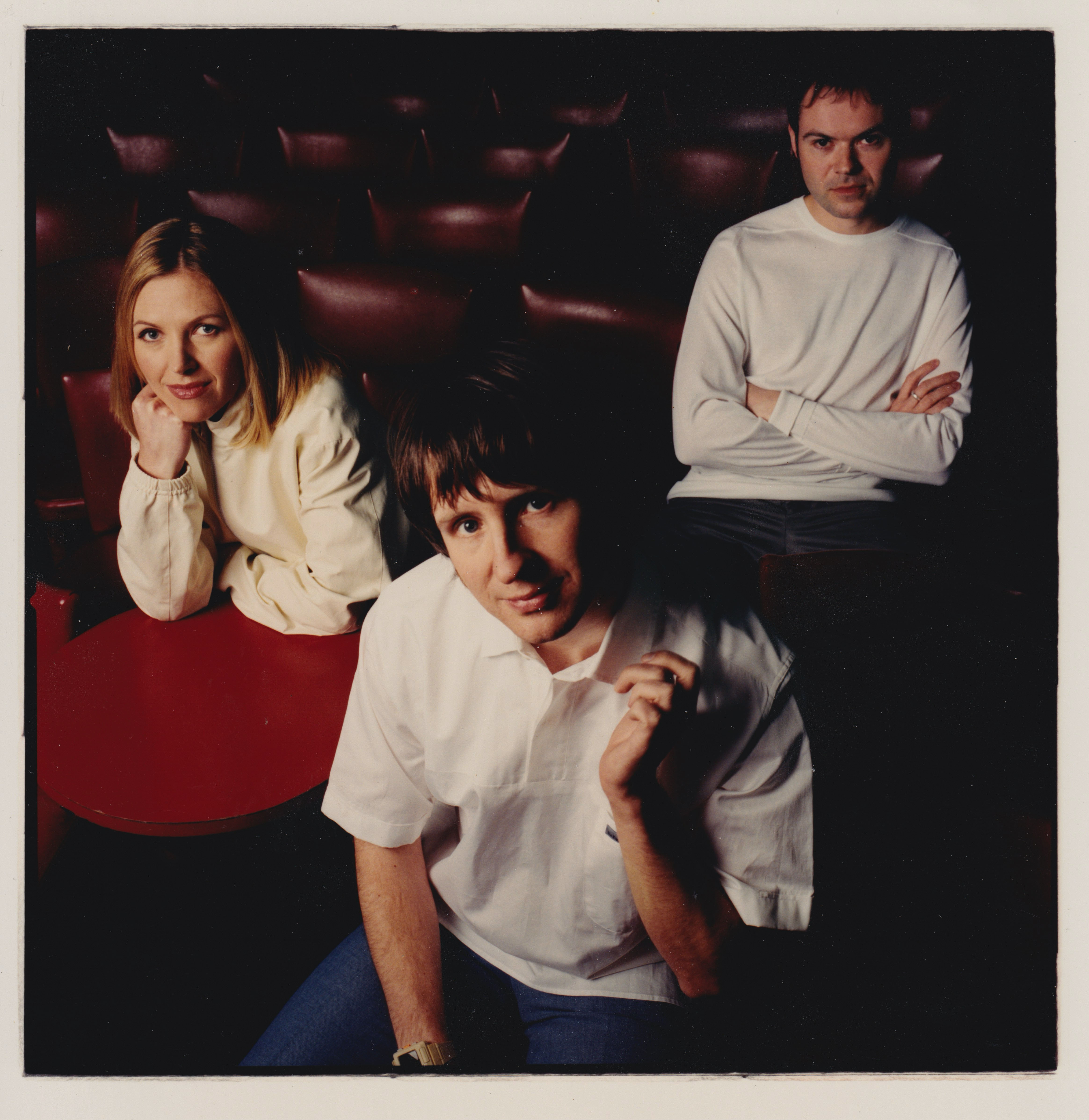
Saint Etienne had their own ‘It’s a Wonderful Life’ moment earlier this year. When the trio of Sarah Cracknell, Bob Stanley and Pete Wiggs revealed that their 12th studio album, ‘International’, was to be their last they anticipated, in their own unassuming way, there would be some reaction. The creative act has always been accompanied by a feedback loop involving critics, writers and fans. Factor in commercial considerations – records sold, tickets shifted and the like – and a group can generally gauge their popularity.
But critical hosannas, chart positions and moments of being flavour of the month aside, do bands ever get to see what they have really meant to people down the years? Do they get an insight into how their songs have soundtracked people’s lives – the good, the bad, the mundane? Do they understand the emotional succour they provide? Do they get told about the moments when the opening chords of the second single from their third album provide that Proustian hit of being transported back to a time and place? This is what Saint Etienne’s announcement provoked – a tsunami of memories, reflections and celebrations.
“It was more overwhelming than I thought it would be,” says Pete Wiggs from the kitchen of his house in Hove, where he’s been joined by his two friends and band-mates – the ordering is crucial – to look over the last 35 years. “I suppose we thought some people might be sad, but nothing as extreme as it has been. All the lovely stories are amazing; it’s been tear-jerking some of them. It’s nice to know that we’ve somehow made an impact – a nice impact – on people. Something positive. It means that they got the emotions of the records and that the records have had a life in their life. It’s amazing.”
While the outbursts haven’t exactly afforded them a glimpse into what the world would have been like if they hadn’t existed (per George Bailey in Frank Capra’s cherished film) – one shudders at the drabness – they have been able to observe, in real time, thanks to social media, the very real affection in which so many people hold them. As Stanley notes, it’s something they were wholly unprepared for.
“No, not at all,” he smiles in between mouthfuls of a cinnamon bun that Wiggs has kindly supplied for the occasion. “It is like reading your own obituary. I was thinking about that bloke from Fairport Convention (Dave Swarbrick) who they thought was dead, but wasn’t; he got to read his own obituaries.”
“Was it P.T. Barnum who got a newspaper to show him the obituary they had written just before he died?” asks Wiggs. “Just to check what they said.”
“It’s been really touching,” says Stanley.
Enough to make them reconsider their decision, perhaps?
“No, no,” laughs Cracknell. “It’s the right time. I always wanted to keep the legacy – our legacy – intact and I think it’s a good time to stop. Yeah, good job.”
“We supported World Party?” says a disbelieving Stanley. “I have absolutely no recollection of that whatsoever. What a weird combination. At the Leadmill? No memory.”
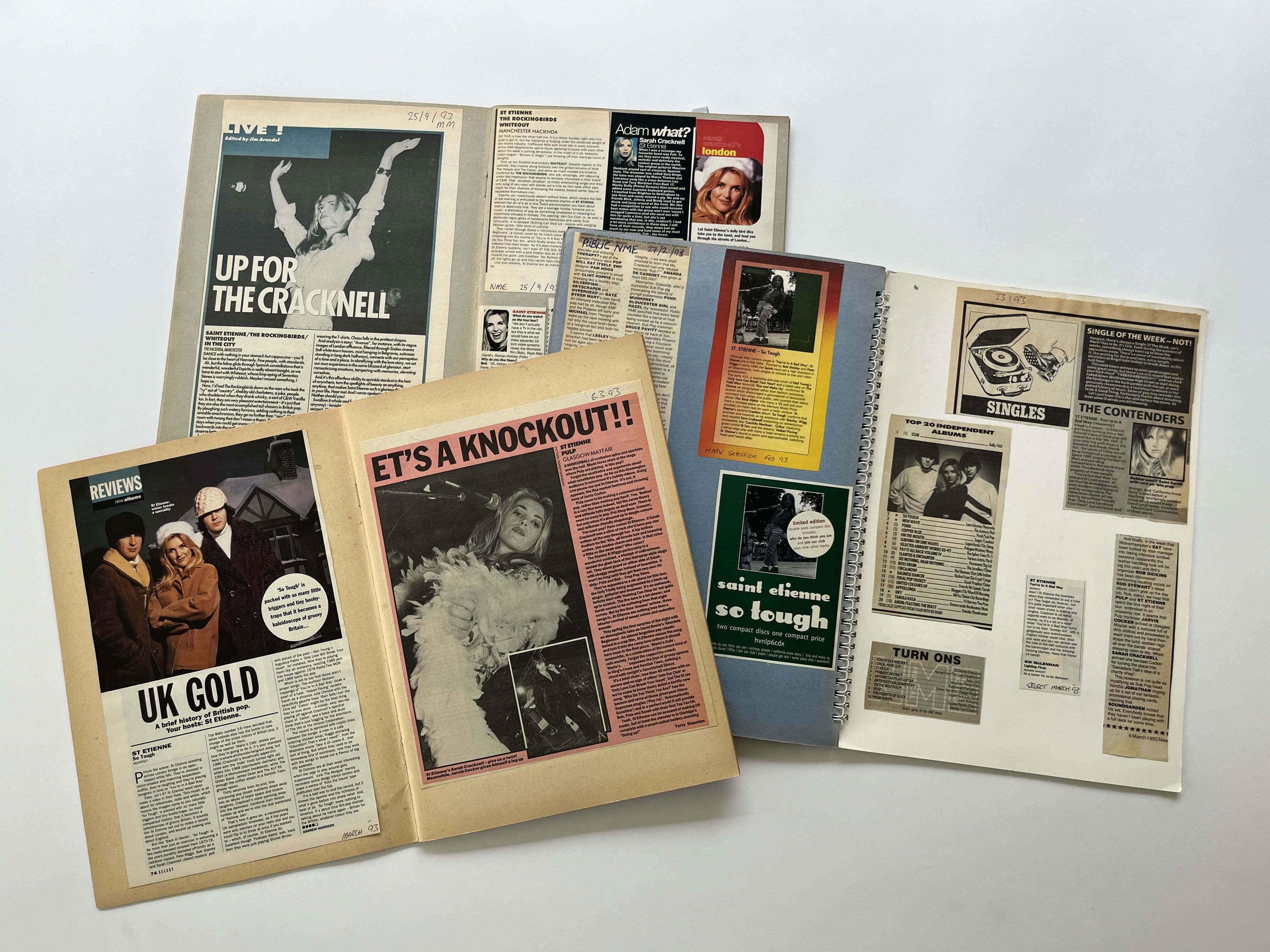
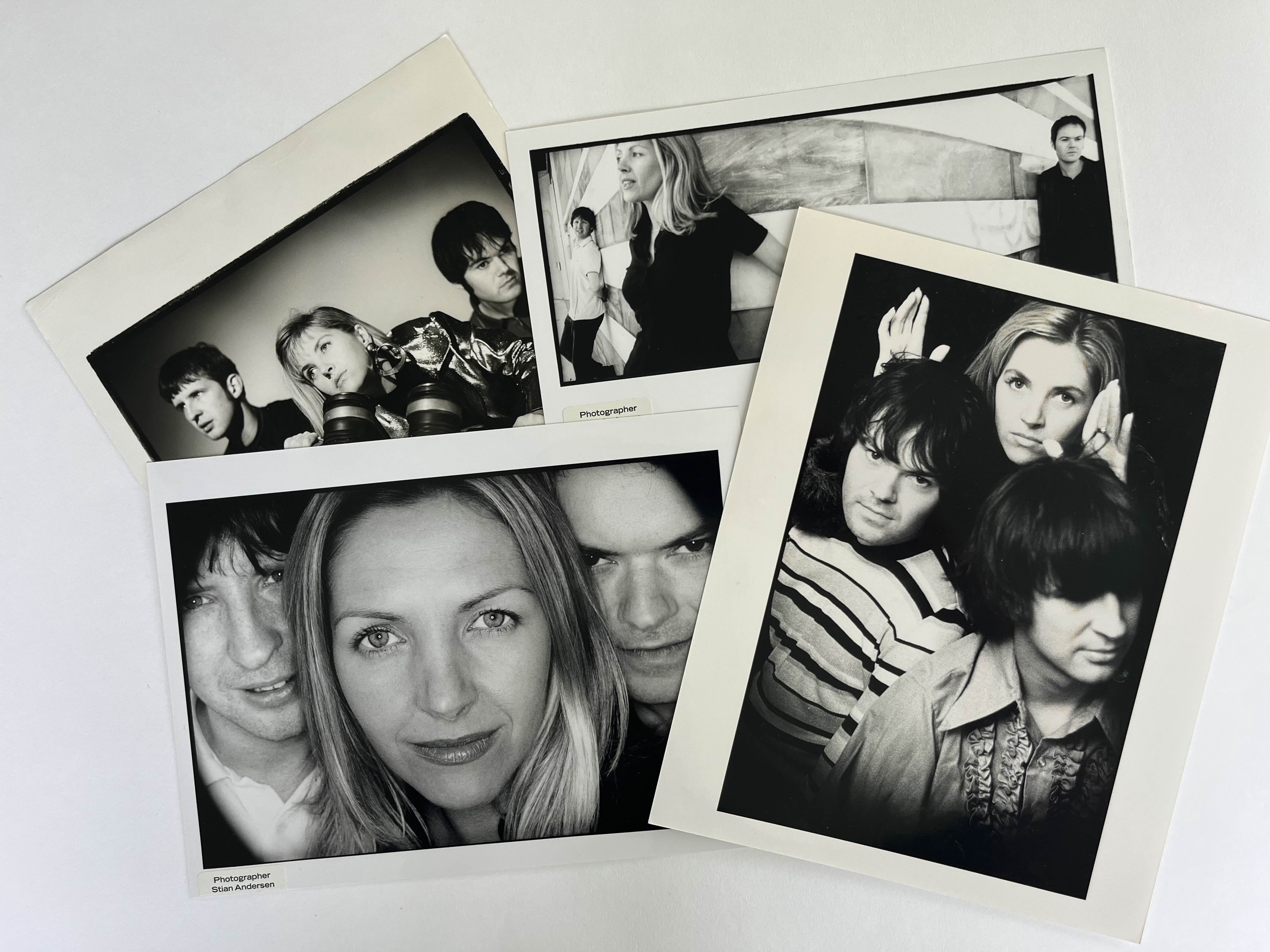
Huddled around Wiggs’s kitchen table, which is buckling under the weight of countless envelopes stuffed full of old photos, contact sheets, tour itineraries, ‘access all areas’ passes and other Saint Etienne-related ephemera, Cracknell, Stanley and Wiggs are not so much on a stroll down memory lane as being hurtled, at great speed, down a memory motorway. The prized possessions in this Saint Etienne bric-a-brac are Cracknell’s scrapbooks, lovingly assembled from the moment she joined the band in 1991, following the release of their third single, ‘Nothing Can Stop Us’. They conclude in 1994, not long after a new band called Oasis had supported them (“They were great,” she remembers. “Very friendly, especially Bonehead. He was very sweet”), perhaps because the novelty had worn off and being pop stars of sorts was now what they did and it wasn’t going to end any time soon.
An incredulous Stanley and Wiggs have never seen the books before – one has a photo of Tom Cruise on the cover – while Cracknell has pushed them to the back of her mind.
“I vaguely remember sticking things in,” she says, sheepishly. “I know it’s me because I recognise the handwriting. I never realised there were so many. It’s mostly pictures of myself of course!”
It’s all in there. The positive reviews (Rolling Stone calling their second album, ‘So Tough’, “visionary pop”); the bizarre references to forgotten bands (“Saint Etienne can be humorous and really emotional at the same time, without verging on Sultans of Ping territory”); photos from an appearance on early 90s late-night TV staple ‘The Word’ (Sarah sporting a feather boa, natch); their idiosyncratic DIY adverts (one featuring the band that performed the original version of ‘Who Do You Think You Are’, Candlewick Green, prompting Cracknell to mockingly point out: “Another one of our adverts that sold us nil more copies”). There are lyrics reprinted in Smash Hits, too, and a strange piece in Peterborough’s Evening Telegraph on how female-fronted bands had become the norm.
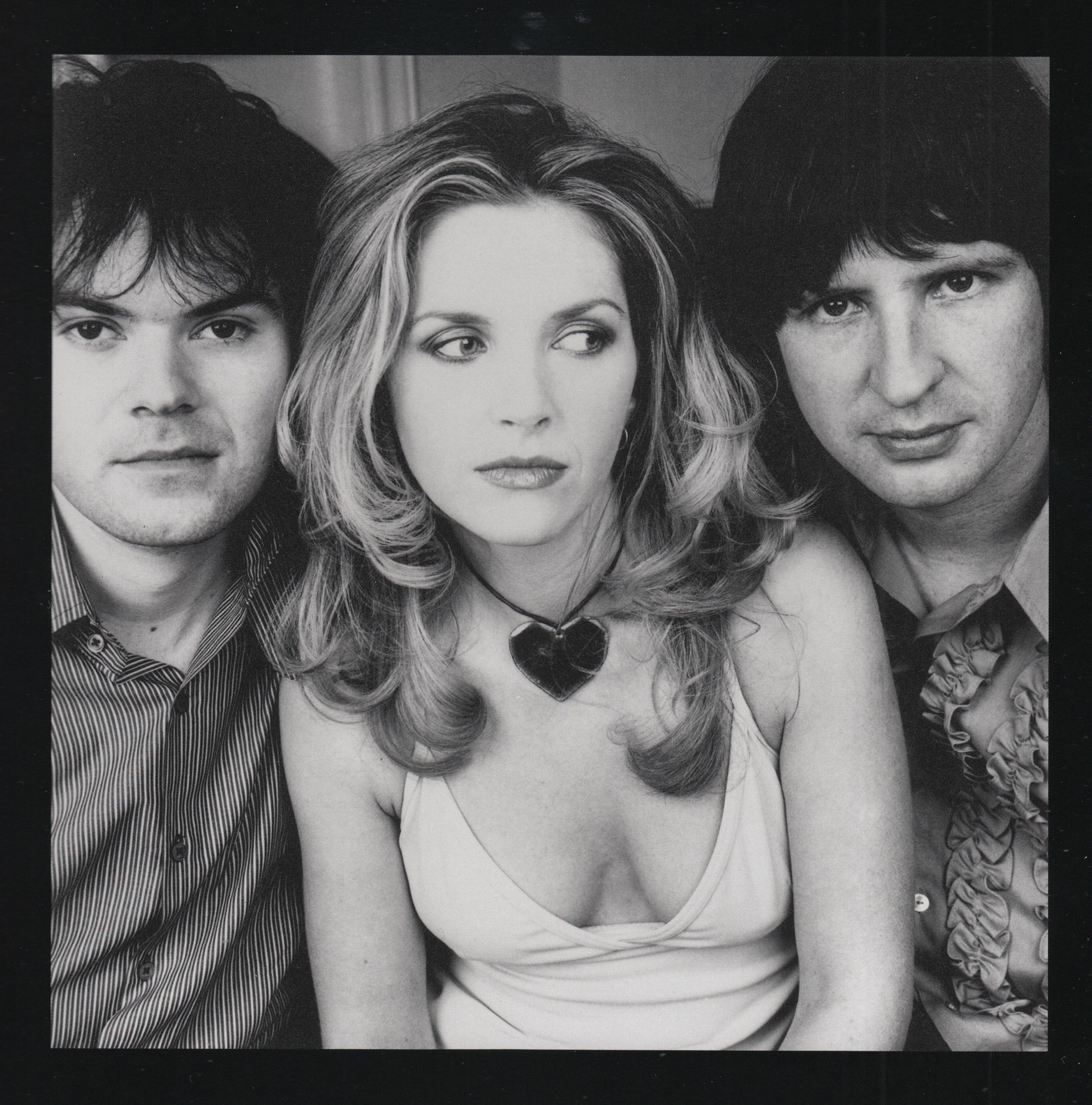
There are also numerous puns on their name, some so oblique and shorn of context it’s hard to tell if they’re funny or not, and tales of aftershow parties attended by other liggers with attitude (Rob Newman, Suede, Primal Scream, Silverfish, Swervedriver, Chapterhouse, Mark Lamarr). And there’s the embellished press release explanations of how they all met: in Croydon’s first floatation tank in Bob and Pete’s case, and in the bathroom of Burger King for Sarah and the boys.
“This is great,” beams Wiggs. “I want one!”
The past they say is another country. When Saint Etienne emerged in 1990, bright-eyed, brimful of ideas and excited by the possibilities a new decade offered, many of the old school didn’t know how to receive them. The decrepit duffers certainly did things differently. Was Saint Etienne’s cover of Neil Young’s ‘Only Love Can Break Your Heart’ indie, dance, indie-dance or pop? Were the duo from Croydon to be taken seriously? Or were they harbingers of those very 90s conditions, kitsch and irony?
“Some mags, like Q, were a bit sniffy,” Wiggs recalls. “We weren’t serious enough for them. And we were caught between two stools – indie and dance. A lot of them didn’t like dance music at all. Or indie.”
“The press couldn’t label us properly,” says Cracknell. “We were confusing to them so we were arch. They didn’t get it so we must be arch. And kitsch.”
In truth, the band were (and remained) whatever you wanted them to be. ‘Only Love Can Break Your Heart’ wasn’t indie, dance or pop, but all of those things at the same time. No wonder it’s heralded as a Balearic classic today, aided by that Weatherall remix. They weren’t arch, ironic or kitsch either. In a musical environment that was still highly segmented, and which encouraged such tribalism, Saint Etienne confounded many because they didn’t subscribe to one narrow worldview. They were the suburban mods with magpie minds who adapted the musical larceny favoured by hip hop, which saw them chime with the post-1988 London club scene.
In interviews they’d wax lyrical about figures such as David Essex, The Monkees and Billy Fury as much as The Beach Boys, Bomb the Bass and Public Enemy. “I remember doing an interview with Melody Maker, I think it was,” recalls Stanley, himself a sometime music journalist who has written two grand compendiums on pop music, 2013’s ‘Yeah Yeah Yeah’ and its 2022 prequel, ‘Let’s Do It’. “We got hammered. We ended up talking about ‘Dazzle Ships’ by OMD and how it was a big influence on us. The interviewer just didn’t believe us. ‘No, no, no, everyone knows that’s a rotten album,’ he said. He thought we were taking the piss. And we weren’t. Now of course everyone thinks it’s a classic. People just had much more hardened ideas about what was good and bad, I think – certainly in the music press.”
“And then people didn’t believe that we could like Joy Division,” interjects Wiggs, “as if we’d made it up to sound cool.”
But then for Stanley and Wiggs – and thereafter Cracknell – it was never about being cool. Their second single, after all, was another impossibly modish cover of ‘Kiss and Make Up’ by indie popsters The Field Mice, mainstays of the twee Sarah Records scene. For Saint Etienne, it was all about the power of the imagination. Thanks to advances in technology – specifically sampling – the only limit to their sound was their own inventiveness. If they could dream it they, along with producer Ian Catt, the band’s secret weapon, would try to bring their visionary sketches to life.
“He [Catt] was really patient with us,” remembers Wiggs. “We didn’t have the terms to express ourselves, so we’d be saying ‘not like that’ or ‘can you not do the noodly bit?’. And we wanted to whack reverb over everything. “
“We were listening to a lot of dub!” Stanley reminisces.
He continues: “Talking about things being categorised, that [seeing where your imagination could take you] was only happening in hip hop. We thought if you applied that to pop music, or whatever, we wondered what it would sound like. That was it really. I suppose other people were using samplers, like Big Audio Dynamite, but not in the same way. We were just throwing everything at it. ‘Foxbase Alpha’, certainly, it was all the music we liked. We liked My Bloody Valentine, so we’d include feedback on things. If you hear the outtakes of ‘Foxbase Alpha’ that wouldn’t have made such a good album. It didn’t all work.”
Buoyed by the adventurous spirit into which they were born, their sound has always been an amalgam and, most importantly, one governed by no rules. Not least because, as non-musicians (Wiggs has since learned to play keys), they didn’t know what the rules were.
“If it sounded good, it worked,” says Stanley.
“Especially with samplers,” adds Wiggs. “You can take a sample from one record and another from another and technically they shouldn’t go together, but we’d take the chords or whatever…”
Cracknell: “And Ian would make it work.”
“Having learned a bit about harmonies and theories since then, I can see how you’re not supposed to do certain things,” smiles Wiggs.
Cracknell: “No limits.”
At which point the trio collapse into giggles, eventually explaining why any reference to the Belgian-Dutch dance-popsters 2 Unlimited always raises a smile – they were on ‘Top of the Pops’ performing ‘No Limit’ when Saint Etienne first appeared on the show (alongside David Bowie’s Tin Machine and The Grid).
This sonic wanderlust is apparent across all their albums. If ‘Foxbase Alpha’ and ‘So Tough’ are exemplars of their widescreen love of sunshine-flecked, sample-fuelled Balearic symphonies, then 1994’s ‘Tiger Bay’ was a stunning diversion into what would eventually be called folktronica. Elsewhere, they dipped into post-rock electronica (‘Sound of Water’), conceptual kitchen-sink vignettes (‘Tales from Turnpike House’), rousing disco and Euro dance (‘Words and Music’), the dreamlike textures of vaporwave (‘I’ve Been Trying To Tell You’) and even their own impressionistic take on ambient music (last year’s gently affecting ‘The Night’).
“It’s not a concept as such, that’s perhaps too extreme, but a framework,” Wiggs says of their relentless sonic snooping. “The most obvious one was ‘Tiger Bay’ which was folk meets techno. When you say it, it’s quite nice because it helps you come up with ideas.”
“And then ‘Tales from Turnpike House’, we thought we’d write an album where each song was set in a different flat within a tower block,” says Stanley. “That was quite freeing. You could write lyrics that were little scenarios. Being fans of music is like being in a playground. You can do what you want. There’s no point in limiting yourself but, having said that, we always liked our albums having some unifying idea so they’re not just random selections. That’s for the B-side collections! Random genres thrown together.”
Another curiosity of the band’s career is that despite – or, rather, because of – all these digressions there isn’t a recognised masterpiece in the Saint Etienne canon. This is no slight. In fact, reading over reviews and critiques of their 12 albums, it’s clear that each one has been heralded as “the band’s defining masterpiece” in various quarters.
“I think our fanbase has changed depending on the record,” suggests Cracknell.
“And some have stuck it out!” laughs Wiggs.
“We used to be really popular in Sweden until we made ‘Good Humour’ and then they went off us,” smiles Cracknell. “I think we’re all right there now. We’ve redeemed ourselves.”

Of course the real reason for their enduring popularity and sustained quality has been the fact that, at heart, all three are unabashed fans of music, particularly pop. They are fluent in its lingua franca and understand its potency, both visceral and factual. For Saint Etienne pop music is fun, serious, ludicrous and life-affirming. It is one of life’s greatest vessels of joy, celebration and knowledge. It is everything and nothing. As such, their music has always been welcoming, immersive and underpinned by a refreshing optimism. Or in Wiggs’s succinct approximation: “It’s 2 Unlimited and Motown.”
“I think all of us remembered what it was like looking at record covers and trying to get more information out of it,” explains Stanley. “Like sleevenotes.”
“We’d also throw everything at it in case we didn’t get a chance to make another record,” recalls Cracknell.
“Getting gold lamé suits was fun because you might not get the chance to do that again either,” Wiggs grins, recalling that first appearance on ‘Top of the Pops’.
Unsurprisingly, their salad days are mostly looked upon with affection. The early 90s were an exciting time, musically and culturally. Pop time was still progressing in a forward motion and the band sensed they were part of something substantial.
“We felt like we were making a bit of a difference, that we were doing something that was important,” says Cracknell.
“We definitely felt some kinship with other bands, like, you know, Pulp,” offers Wiggs.
They purposefully swerved Britpop. Despite being part of Stuart Maconie’s proto-Britpop feature in Select magazine (titled, playfully, “Who Do You Think You Are Kidding, Mr Cobain?”), when the dust settled and the movement became far more insular and parochial, Saint Etienne ducked out and went to record ‘Good Humour’ in Sweden. “A conscious decision,” says Stanley. “We just found all that flag waving really off-putting. And then the next one we did in Germany (‘Sound of Water’).
Of course, trying new things was always part of their mission statement. “We liked to inject a bit of a new flavour in there,” says Wiggs. “And it was always fun going away and doing a residential-type thing.”
“Like a little family!” affirms Cracknell.
“You remember those times,” notes Wiggs. “So when people say we’ve soundtracked their lives, we’ve also soundtracked our lives. That’s what the albums do. We don’t listen to our own stuff – unless we have to – and when you do, it’s quite nice, the memories come back and you remember what you were doing then. Vaguely at least. It’s like a photograph.”
Recollections of foreign jaunts bring us back to ‘International’. Despite being routinely referred to as “the quintessential London band” – and there’s certainly some truth in that – Saint Etienne have long embraced all continental flavours. On the track ‘Girl 7’, from ‘Foxbase Alpha’, alongside mentions of the capital’s Primrose Hill, Boston Manor and Gospel Oak, are references to Staten Island, São Paulo and Costa Rica. Named after a French football team, the group have always been unashamedly international.
“Definitely,” says Stanley, if not forcibly, then with a little more vigour than anyone else on a blissful mid-summer’s day in East Sussex. “I mean, the ‘Kiss and Make Up’ cover was a European flag. We did a fan club EP and the artwork was flags with crosses through them. There’s always something to be found in other people’s cultures and countries that’s going to be interesting, so why would you ignore that? I don’t think any of our songs are overly political, but hopefully there’s a fairly common thread bubbling under that people can spot, so, yeah, it’s called ‘International’ for that reason.”
Musically, ‘International’ brings the band back to where they started too. Cracknell points out that there’s a bit of everything from their previous 11 albums packed into its lean 42 minutes. It’s a magical, uplifting listen. A fitting goodbye.
“As bookends they’re nice,” explains Stanley. “We did have that in mind. ‘Brand New Me’ is clearly a nod back to ‘Nothing Can Stop Us’ and ‘Spring’ – that sound from ‘Foxbase Alpha’. I thought like anybody we’d get five years. Like David Bowie said. We got a lot longer than that. We got 35 years! A completely different song!”
The album is also a triumph of collaboration, featuring songs recorded with Nick Heyward, Tom Rowlands (The Chemical Brothers), Jez Williams (Doves), Erol Alkan, Orbital’s Paul Hartnoll and Confidence Man’s Janet Planet.
“Adam Ant was on the longlist,” says Stanley. “That would have been nice. Don’t know if he would have said yes. Sparks didn’t get back to us. But everyone else did. And everyone else said yes.”
In these uncertain times, such co-operation and inclusivity (hallmarks of Saint Etienne) are an anchor and a boon. It’s a shame that we won’t get to hear more music from their productive minds but we do have 12 studio albums, countless compilations and remix projects with which to remember them by. Their parting – on their terms; no messy musical differences, deaths or record companies pulling the rug – is in keeping with their career.
“We never squabble anyway,” says Cracknell.
“We’ll save that for the final shows. It’ll be full Spinal Tap!” notes Wiggs, alluding to Saint Etienne’s intention to sign off next year with a series of dates, possibly a tour. Their own ‘Last Waltz’ perhaps?
“Yeah, let’s get Neil Diamond out on stage with us,” says Stanley, ever the effusive pop lover.
Back at the kitchen table, the scrapbooks get one last viewing. The reason for Stanley not being able to remember performing alongside World Party becomes clear – he missed that gig.
Photos of Cracknell in a vibrant Hysteric Glamour suit featuring a ‘Partridge Family’ cartoon (“We got it in Japan. We were let loose in their factory”) prompt further memories of wearing it when she appeared on ‘The Big Breakfast’ with the Zig and Zag puppets. “It was the best day ever. I loved it.”
Wiggs then debates whether they were ignored by presenters Richard Madeley and Judy Finnigan when the band rocked up on ‘This Morning’. He thinks they did. Stanley disagrees.
“No, Richard said something nice,” Stanley recollects. “I remember that ITN newsreader. God, what was his name? What programme would we have been on where he’d have been on? Alastair Stewart, that’s it. He said: ‘What a great band!’ What the hell programme was that? Richard and Judy was funny, because it was up in Liverpool at the Albert Dock and it was Halloween. I think we did ‘He’s on the Phone’ and the whole backdrop was kids dressed up as ghosts…”
Cracknell: “And bats hanging from the set.”
“Quite surreal,” says Stanley. “Probably on YouTube.”
A photo with the late ‘Supermarket Sweep’ presenter Dale Winton heralds another memory. “We did a Christmas gig at the London Palladium,” Cracknell says. “He came onstage with a shopping trolley full of presents, which he threw into the crowd. He kept calling me Susan. ‘Darling Susan, Susan, where’s my dressing room, Susan?’”
Finally, fittingly, Cracknell recalls a “brilliant journey from a festival to the airport with The Prodigy. I sat next to Keith; he was lovely. A little sweetie”.
“We played Roskilde,” recalls Stanley, “and we were in a tent with Björk, Orbital, One Dove and The Prodigy were on last – we were in the middle. I just sat there all day watching them. It was incredible.”
Who has a bad word to say about Saint Etienne? Friends and family, they have it all. It really has been a wonderful life.
Read our Saint Etienne Dancefloor Starting XI here
This article first appeared in issue eight of Disco Pogo.